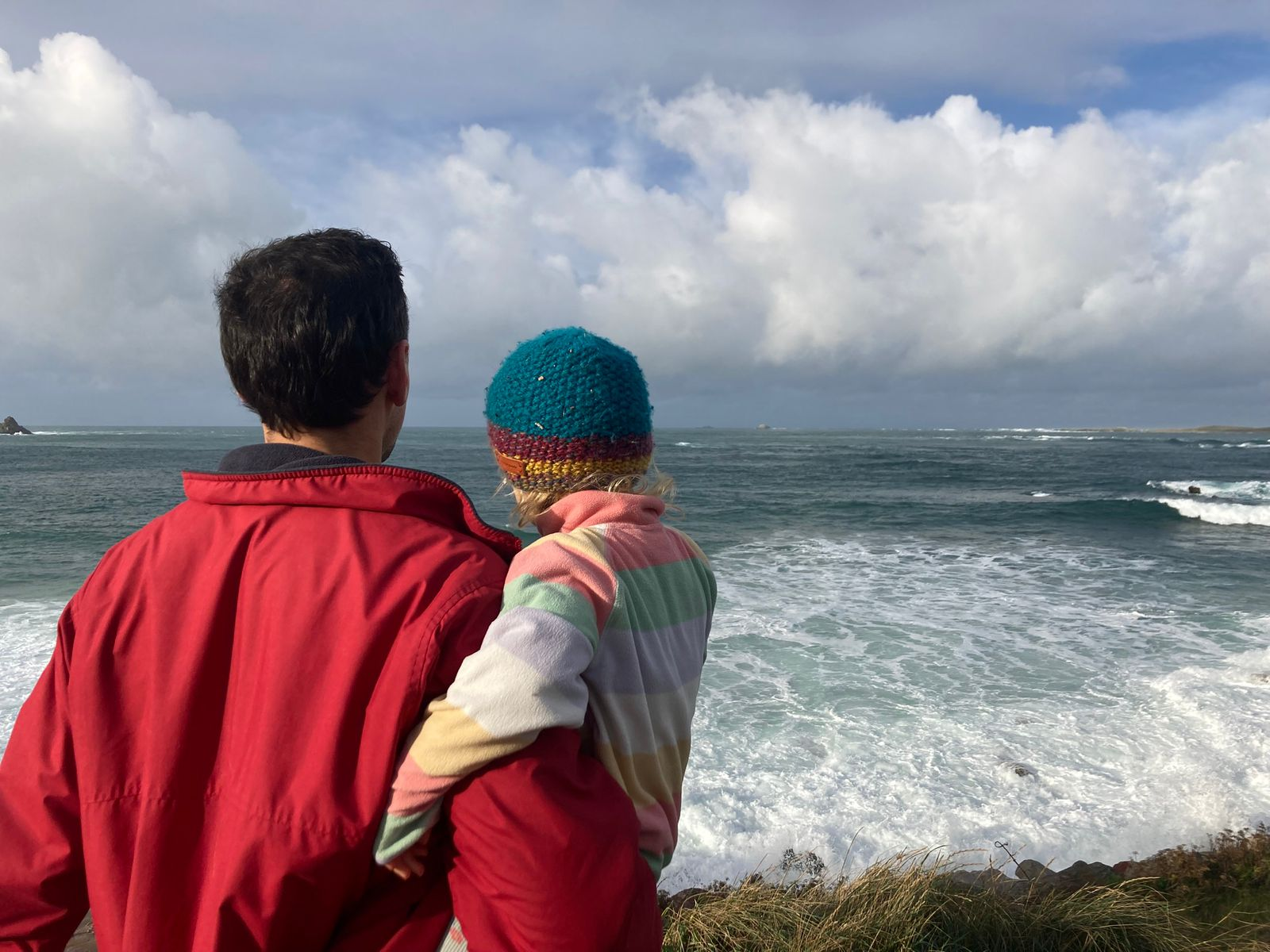
An interview with Ian Corder.

Currently Reading:
Let my people go surfing: The education of a reluctant businessman, by Yvon Chouinard
What is your current job/jobs?:
I work in corporate social responsibility (CSR), helping businesses around the world measure and reduce their impact and exposure to environmental, social and governance issues. Practically, this means I divide my time between analysing data about CSR issues and managing projects on behalf of companies, who are typically in sectors like telecoms, technology and construction. These companies have long and complex supply chains around the world, ranging from electronics manufacturers, to datacentres and AI, to mining companies, to small subcontractors. So I spend a lot of time on calls with customers and their suppliers, trying to truly understand how their businesses work and how they can be adapted to cause less harm. And I’m able to do this fully remotely from Alderney, thanks to modern digital connections.
What do you enjoy about working remotely from Alderney?:
Working remotely from Alderney has lots of benefits for me. I feel very lucky to be able to do a job that allows me to speak to people around the world and learn about interesting businesses and how they work, but without having to travel constantly to meet customers.
Working remotely means I can manage my work-life balance in a way which suits me. I don’t have a daily commute, which means I can drop my daughter off at nursery in the morning and still start work by 08.30. I can also be more intentional about how I collaborate with others in my team, scheduling meetings when we need to bounce ideas around, or sending emails or notes when asynchronous working is more effective.
I can also enjoy everything Alderney has to offer – which means being on the beach by 5 o’clock in the summer! I’m re-learning how to windsurf which means beach time is vital and serious business…
What has your career path been/how did you end up in your current job? What skills and qualifications have you obtained and found most useful?:
After school I went to university and studied Land Economics. I wasn’t sure what I wanted to do, but I had always been interested in the natural world and figured this would potentially lead into a career in property or surveying.
As it happened, the financial crisis came along in 2008 and there were very few opportunities for new graduates to get into property! So I had a series of jobs in large engineering companies (Balfour Beatty, Rolls-Royce Defence and the UK Environment Agency) which were all fascinating and gave me great exposure to managing people and projects, as well as harder skills like financial analysis and digital skills. Along the way, I picked up qualifications in accounting, project management and strategy, and also became a Chartered Environmental Manager, focussing on water management.
I ventured into consulting and starting my own business in 2019, and since then have run different start-ups and learned a lot about entrepreneurship. I still use some aspects of all my qualifications which is really satisfying – I don’t think any of them have been wasted.
What was your motivation to move to Alderney?
I moved to Alderney with my wife and dog in 2019, initially as a bit of an experiment as we were between jobs and houses. We ended up staying on Alderney during the Covid pandemic, and realised this was a wonderful place to be stuck! Then our daughter arrived in 2021, and we realised Alderney was also an amazing place to bring up a child – the safety, access to nature, and living in a close community of friends and relatives was more valuable than we could have imagined.
Do you work remotely? If so, what do you find are the benefits and drawbacks?
Remote working from Alderney is brilliant, it really provides you the greatest benefits. As well as living in a beautiful and friendly place, I avoid the commuting and travelling which was inevitable in other jobs.
I’m a big convert to remote working, but it has to be done intentionally and in a planned way. You can’t drop someone into a remote role and assume it will work, it has to be right for the person, the role and the organisation.
Remote working really suits me now I am more experienced and comfortable in what I do. If you need a lot of 1-2-1 unstructured support, that can be difficult remotely. Some younger workers or new starters find it difficult to learn what they need, because organisations assume that knowledge is built up organically through personal interactions. So training and onboarding needs to be really structured and effective to make sure people can deliver to their best.
Roles and organisations also need to be set up for remote working. There are practical considerations like how digital security is managed, how computers and files are organised. You need good digital tools to run meetings (like MS Teams), collaborate on documents (like Sharepoint), and track progress (like Trello). You also need the organisation as whole to prioritise the remote worker if everyone else is there in person.
I’m always happy to guide people interested in remote working on Alderney – you can get in touch with me through the Hub at info@openalderney.com.